
Switch · Low effort
Plant and protect a tree
Every monsoon, saplings go into the ground by the truckload at vriksharopan drives. The trees you see grown ten years later are the ones somebody kept visiting after the photos were taken.
Why it matters
- A grown native tree is the cheapest cooling your street will ever get — shade for the sabziwala, the parked scooters, and the dog that sleeps under it.
- Saplings rarely die on planting day. They die in the first two dry seasons, when the drive is over and nobody owns the watering.
- Native species — neem, jamun, peepal, amaltas — feed local birds and insects in a way ornamental imports never will, and need far less looking-after once established.
- One tree you protect for two years teaches your mohalla more than a hundred-sapling drive that no one revisits.
795 members shared · 1 adopted
Start in 6 steps
Choose a native tree, not the one the nursery pushes
Ask your nursery what is native to your district, and go in with names: neem, jamun, karanj, arjun, amaltas — or sahjan (drumstick) if the plot is small. Skip whatever is stacked at the front because it "grows fast". Fast usually means thirsty or invasive: eucalyptus drains groundwater, vilayati kikar crowds out everything around it, and conocarpus is so poorly suited here that Gujarat and Telangana have banned planting it. A native species has spent thousands of years learning your rainfall — once its roots are down, it largely looks after itself.
Pick a spot where it can stand for thirty years
Look up and look down before you dig. Overhead wires, a wall it will lean into, an underground water line — any of these means the tree gets hacked back at year five. Leave a couple of metres from walls and drains, and picture the full canopy, not the sapling in your hand. In a society, get the spot agreed at the committee meeting first. A tree planted without asking is a tree that gets cut without asking.
Plant it properly: a wide pit, some khaad, and no buried stem
Dig a pit about two feet wide and two feet deep — wider than feels necessary, because loosened soil is where young roots run. Mix the dug-out soil with compost or gobar khaad; there is no need for chemical fertiliser. Set the sapling so the point where stem meets root sits level with the ground — burying the stem is a slow way to rot it. Fill, press the soil firm, water slowly till it pools, and spread dry leaves on top as mulch to hold the moisture.
Put up a tree guard the same day
A young stem is exactly goat height, and in most towns grazing animals and cricket balls kill more saplings than drought does. A bamboo or wire-mesh guard from the local welding shop works; so do three sticks and an old sari or plastic jaali tied around them. Whatever you use, put it up the day you plant, not next weekend. Then check it monthly — a collapsed guard leaning on the stem does more damage than no guard at all.
Water it through the first two summers
Monsoon planting buys you three free months; the real test is March to June. A full bucket once or twice a week beats a daily splash — deep, infrequent watering pushes the roots down instead of keeping them lazy at the surface. The old matka trick still works best: bury a matka with a small hole beside the roots and refill it on your way past, and it drips for days. After the second monsoon, a native tree can mostly fend for itself.
Adopt it — the habit is checking, not planting
Mark your tree, give it a name if that helps, and set a monthly reminder. Each visit takes two minutes: is the guard standing, is the soil cracked, has someone dumped malba on it? Post its photo to the community each season — you will notice that the members whose trees thrive keep posting the same tree, not a new one every time. And if you join a plantation drive, pick one specific sapling and adopt it before you leave. That is the whole switch.
What goes in
| Add | Skip |
|---|---|
| Neem — hardy, deep shade, grows almost anywhere | Conocarpus — banned by Gujarat and Telangana; roots invade drains and pipes |
| Jamun — native shade plus fruit the whole lane will claim | Eucalyptus — drains groundwater, gives thin shade |
| Amaltas, karanj, arjun — avenue trees that belong here | Vilayati kikar (Prosopis juliflora) — invasive, crowds out native growth |
| Peepal or bargad — where there is real room: parks, school grounds, temple land | Ornamental palms — decoration, not shade, and no home for birds |
| Sahjan (drumstick), amla, curry patta — small compounds, useful harvest | Whatever the nursery pushes purely because it "grows fast" |
Members doing it

আজকে চারা গাছটিতে জল দিলাম। 🌱💧 নিয়মিত যত্নেই চারা গাছ একদিন বড় হয়ে উঠবে। 🌳
Nirmal mahato · 82 cheers

গাছ লাগান, প্রাণ বাঁচান 🌱 সবুজ পৃথিবী গড়ুন, পরিবেশ রক্ষা করুন। আসুন, সকলে মিলে
Sri Sri Bal vidya kendra · 77 cheers
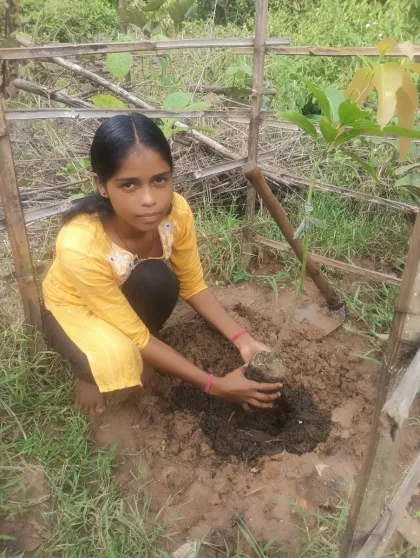
আজকে আমি আর একটা আম গাছ গব্বর স্যার দিয়ে রোপন করলাম । যাতে আমার আম গাছ টি বড় হ
Nilima Mahato · 70 cheers

Hydroponics (मृदाविहीन संवर्धन)
Raj kumar shukla · 69 cheers

কয়েকদিন সার দেওয়ার পর আজকে চারা গাছটিতে জল দিলাম।গাছের সঠিক পরিচর্যা ও নিয়মিত
Nirmal mahato · 69 cheers

চারা গাছটির গোড়ার মাটি হালকা করার পর আজকে Carbendazim 50% WP ছত্রাকনাশক প্রয়োগ
Nirmal mahato · 68 cheers
Common questions
What is the best time to plant a tree in India?
Just before or early in the monsoon — June or July in most states. The ground stays moist for months without you carrying water, and the roots settle in before winter. If you have missed it, either wait for the next monsoon or commit honestly to watering: a summer-planted sapling with a weekly bucket does better than a monsoon one that everyone forgets.
Which trees are good to plant near a house?
For a small compound, pick trees with a modest canopy and something to give back: sahjan, amla, curry patta, karanj. Keep the giants — peepal, bargad, neem at full size — for parks, school grounds and temple land, because their roots need room and will eventually find your foundation. Tell the nursery how much space you actually have and ask for the mature size, not the pot size.
Do I need permission to plant on the roadside or in a park?
Usually yes — from the municipality, panchayat or the horticulture department. Many of them run their own plantation drives and hand out free saplings, so joining is often easier than asking. Inside a society, take it to the committee. It feels like bureaucracy, but a recorded tree is a protected tree; an unrecorded one gets cleared by the next contractor without a second look.
Why did my sapling die even though I planted it properly?
The usual suspects, in order: nobody watered it after the first month; there was no guard and something grazed it; the stem was buried too deep and rotted; or it was the wrong species for the soil. It is almost never the seed or bad luck. Fix whichever one applies and replant in the same spot — the pit you dug is still an asset.
How long does a new tree need watering?
Plan for the first two summers. A deep soak once or twice a week is the aim — daily sprinkling keeps roots shallow and dependent. A buried matka with a pinhole turns one visit a week into a slow drip that lasts days. After its second monsoon, a native species mostly manages on its own; just check on it during a heatwave.
I live in a flat with no land. Can I still do this switch?
Adopt instead of plant. Most streets have municipal saplings that nobody waters — pick the one nearest your gate, give it a guard and a weekly bucket, and it is yours in every way that matters. Or join a local drive and take charge of specific trees afterwards; even a kirana-bag of water carried on the morning walk keeps one alive. Protecting a tree counts exactly as much as planting one. Often more.