

MILTON Comet 1000 Stainless Steel Water Bottle 1000 ml, Single Walled, ISI Certified I Leak Proof…
Ditch plastic! Choose our stainless steel bottle for a sustainable, stylish hydration solution.
₹249
by MILTON
Check on AmazonSwitch · Free
The bag you refuse at the counter today is the one bag that never blocks a drain, never reaches a landfill, never needs recycling.
173 members shared
The zero-waste habit begins with the word no, not with a shopping list. Refuse comes before reuse and recycle for a reason: the bag you decline needs no disposal at all. So before buying bamboo anything, spend one week just noticing where plastic is handed to you — the carry bag at the kirana, the straw pushed into the lassi, the extra pouch "for safety". Say "bag nahi chahiye" and watch how much never enters your house. This step costs nothing and does most of the work.
Everyone owns cloth bags; the problem is they are in a cupboard while you are at the counter. Fix the location, not the intention. Hang two on the hook where your keys live, keep one folded in your office bag, one under the scooter seat or in the car door pocket. A bag you can reach without going home is the only bag that works. When one comes back full, it goes straight back to its spot — that return trip is the whole habit.
The sabzi mandi is where the thin poly bags multiply — one for tomatoes, one for mirchi, one for dhaniya. Carry one big bag and let the vegetables travel loose together; they were lying in an open pile a minute ago and do not need separate packaging for the ride home. Potatoes and onions do not fight. At the kirana, ask for dal, rice or poha weighed into your own dabba or a paper packet — older shopkeepers remember doing exactly this, and most are happy to oblige a regular.
Carry bags are the visible part. The quieter half is sachets and pouches: shampoo sachets when a bottle lasts months, small ketchup pouches, the water pouch at a function, cling film over leftovers, the cutlery packet that arrives with every food delivery whether you asked or not. None of these is reused even once. Where a bigger pack exists, buy it; where a katori and a plate do the job, skip the wrap; in your delivery app, turn off cutlery once in the settings and it stays off.
People who try to go plastic-free in a weekend usually give up by Wednesday. Pick one exchange and run it for a week until it stops needing thought. Week one: cloth bag for all shopping. Week two: steel bottle filled at home — matka water in summer is better than anything from a fridge anyway. Week three: a dabba handed over for takeaway or parcelled food. Each swap uses something already in your kitchen. By the second month the habits carry themselves.
One person refusing bags helps; a household doing it becomes the default the children copy without being told. Put the cloth bags where everyone grabs them, not just you. In the society, the same logic scales: paper glasses instead of water pouches at functions, a word with the committee about styrofoam plates at the Diwali mela, steel tumblers for the satsang. Nobody needs a lecture — they need to see it working at your place first.
| Add | Skip |
|---|---|
| Cloth or jute bags hanging next to your keys and under the scooter seat | The free poly carry bag at every counter |
| A steel bottle filled at home, or matka water in summer | Packaged water bottles and pouches bought out of habit |
| A steel dabba for takeaway, parcels and leftovers | Cling film and single-use containers |
| Dal, rice and poha weighed loose into your own container at the kirana | Sachets and small pouches where a bigger pack or refill exists |
| Drinking straight from the glass, or a washable straw if you truly need one | The plastic straw that comes by default |
| Steel or leaf plates for society functions | Styrofoam and thin plastic disposables at events |

🌱 আসুন সবাই মিলে গাছ লাগাই, গাছের যত্ন নিই এবং পরিবেশকে সবুজ-সুন্দর করে তুলি। �
Basanti Mahato · 71 cheers

🌳 **हर रोज़ एक पेड़ लगाएँ, स्वस्थ और खुशहाल जीवन अपनाएँ।** 🌿 एक पेड़ सिर्फ़ प्
HARISH KUMAR SEN · 63 cheers
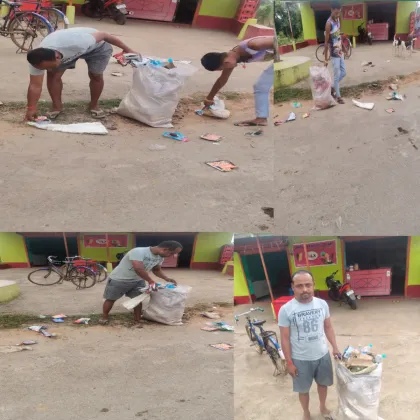
পরিবেশকে স্বচ্ছ ও সুস্থ রাখার লক্ষ্যে আজ প্লাস্টিক ও অন্যান্য আবর্জনা পরিষ্কার ক
Nirmal mahato · 59 cheers

আজকে চারা গাছটির সুস্থ বৃদ্ধি ও ভালো বিকাশের জন্য Ammonium Molybdate (Molybdenum
Nirmal mahato · 59 cheers

Plastic recycling Formed Ecobrick
Raj kumar shukla · 57 cheers

🌿 প্লাস্টিক ও আবর্জনা মুক্ত অভিযান 🌿 পুরো টলি মিলে ইলু হাসপাতাল -পরিচ্ছন্ন কর
Nirmal mahato · 54 cheers
Sponsored · EcoMitram may earn from these links
Ditch plastic! Choose our stainless steel bottle for a sustainable, stylish hydration solution.
₹249
by MILTON
Check on Amazon
Ditch single-use plastics! Choose our stainless steel bottle for a sustainable, stylish hydration solution.
₹189
by Lifelong
Check on Amazon
Stay hydrated sustainably with our leak-proof, insulated water bottle—perfect for every adventure!
₹872
by MILTON
Check on Amazon
Choose the Sirona Menstrual Cup for a sustainable, eco-friendly period solution!
₹239
by Sirona
Check on AmazonGear is optional — the steps above work without buying anything.
Anything designed to be used once and discarded: carry bags, straws, cups, plates, cutlery, ear buds, wrapping film, sachets and water pouches. The Government of India banned a list of these items — including plastic straws, cutlery and thin carry bags — from July 2022, which is a useful mental checklist. A thick container you wash and reuse for years is not single-use; the thin bag your bhindi came home in is.
Mostly no. Many bags sold as biodegradable or compostable break down only in industrial composting facilities, which most Indian cities do not have — in a landfill or a drain they behave much like ordinary plastic. Some are just regular plastic with additives that fragment it faster. A cloth or jute bag you reuse for years beats any disposable bag, whatever its label says.
Use a sheet of old newspaper folded into the bin, or keep the bin unlined and rinse it when you empty it — wet waste going to compost should not travel in plastic anyway, because the bag has to be torn open and picked out before the peels can become khaad. If your building composts, an unlined bin emptied daily is genuinely less messy than a leaking bag.
For about a week, slightly. Then your kirana wala starts reaching for your dabba before you ask — shopkeepers deal with regulars, and regulars with habits are easy customers. Bags cost the shop money, so nobody is offended when you refuse one. The awkwardness is almost entirely in your head, and it fades faster than the habit forms.
Do not let the unavoidable ones stop you from refusing the avoidable ones. Rinse milk pouches, let them dry and store them — collected clean and in bulk, they are one of the few plastics your kabadiwala or local scrap collector will actually take, because clean sorted plastic has resale value. Meanwhile the bags, straws and sachets you can avoid are the ones worth spending your effort on.
Your own waste shrinks visibly within a month — that part you can see in your bin. The larger effect is social: children copy what the house does, neighbours ask about the dabba at the counter, and shopkeepers adjust to what regulars want. Habits in India spread through families and societies, not through individuals — and every such chain starts with one household that made it look normal.