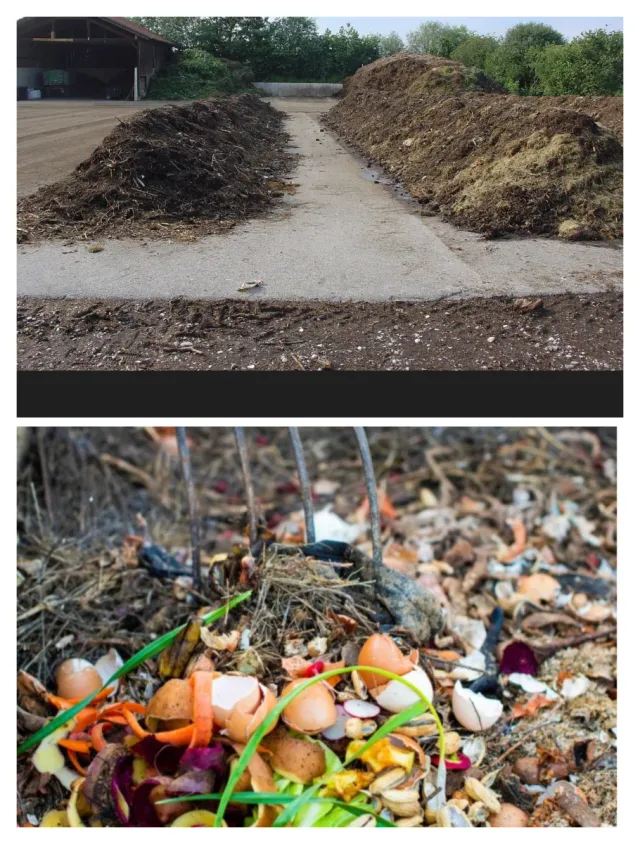

Composting is the natural biological decomposition of organic waste into nutrient-rich soil conditioner. Key Composting Concepts • Greens (Nitrogen-rich): Fruit and vegetable scraps, coffee grounds, and fresh grass clippings. • Browns (Carbon-rich): Dry leaves, twigs, small wood chips, and shredded paper. • Ideal Ratio: Roughly 25 to 35 parts carbon for every 1 part nitrogen (25:1 to 35:1). • Methods: • Hot (Active) Composting: Fast breakdown requiring moisture, oxygen, and balanced layering, managed by aerobic microorganisms. • Cold (Passive) Composting: Slow breakdown by letting organic matter sit naturally over 1 to 2 years with minimal effort. • Vermicomposting: Using earthworms (like red wigglers) to process food scraps into nutrient-rich castings. Popular Composting Drawing & Diagram Ideas You can sketch several common educational or step-by-step illustrations: • The Compost Life Circle (Four-Stage Cycle): • Draw a circular flow chart connecting four phases with arrows: Collect (kitchen scraps) → Compost (bin or pile) → Use Compost (enriching garden soil) → Grow (new plants and vegetables). • Composting Bin with Character: • Draw a cylindrical bucket or trash-style bin with a handle, overflowing with food scraps (banana peels, apple cores) and a friendly cartoon worm saying "Let's Go Compost". • Vermicomposter (Stacked Bins): • Draw a vertical cross-section of 4 stacked bins labeled from top to bottom: 1. New Food Bin (food scraps and worms) 2. Casting Production Bin (active worms) 3. Finished Castings Bin (dark rich soil) 4. Leachate Collection (bottom liquid tray) • Bag of Compost: • Sketch a flexible sack with fold lines, a central graphic of a growing sprout, and small earthworms crawling out of a rich soil pile beside it. For a quick visual walkthrough of these illustrations, you can reference video guides such as the Compost Life Circle TutorialComposting is the natural biological decomposition of organic waste into nutrient-rich soil conditioner. Key Composting Concepts • Greens (Nitrogen-rich): Fruit and vegetable scraps, coffee grounds, and fresh grass clippings. • Browns (Carbon-rich): Dry leaves, twigs, small wood chips, and shredded paper. • Ideal Ratio: Roughly 25 to 35 parts carbon for every 1 part nitrogen (25:1 to 35:1). • Methods: • Hot (Active) Composting: Fast breakdown requiring moisture, oxygen, and balanced layering, managed by aerobic microorganisms. • Cold (Passive) Composting: Slow breakdown by letting organic matter sit naturally over 1 to 2 years with minimal effort. • Vermicomposting: Using earthworms (like red wigglers) to process food scraps into nutrient-rich castings. Popular Composting Drawing & Diagram Ideas You can sketch several common educational or step-by-step illustrations: • The Compost Life Circle (Four-Stage Cycle): • Draw a circular flow chart connecting four phases with arrows: Collect (kitchen scraps) → Compost (bin or pile) → Use Compost (enriching garden soil) → Grow (new plants and vegetables). • Composting Bin with Character: • Draw a cylindrical bucket or trash-style bin with a handle, overflowing with food scraps (banana peels, apple cores) and a friendly cartoon worm saying "Let's Go Compost". • Vermicomposter (Stacked Bins): • Draw a vertical cross-section of 4 stacked bins labeled from top to bottom: 1. New Food Bin (food scraps and worms) 2. Casting Production Bin (active worms) 3. Finished Castings Bin (dark rich soil) 4. Leachate Collection (bottom liquid tray) • Bag of Compost: • Sketch a flexible sack with fold lines, a central graphic of a growing sprout, and small earthworms crawling out of a rich soil pile beside it. For a quick visual walkthrough of these illustrations, you can reference video guides such as the Compost Life Circle Tutorial